• Skip to primary navigation
  • Skip to main content

Adam Rafferty

Funky Fingerstyle Guitar

  • Home
  • Guitar Lessons
    • Free Christmas Tabs
  • My Book
  • Store
  • Tour
  • Blog
    • All Posts List
  • Podcast
    • All Episodes List
  • About
  • Contact
    • NEW – “Ask Adam” Voicemail
    • Booking Contact
    • Contact (email)
  • Get Your FREE Guitar Course
  • Show Search
Hide Search
You are here: Home / Archives for Jazz Education

Jazz Education

How to Sell Your Music Without Selling Your Soul – Part 1

By Adam Rafferty 4 Comments

(This is written especially for college level music students, young musicians considering a career in music and recent music conservatory grads…but also anyone else in the music or arts.)

Many musicians and artists treat “selling” like a nasty disgusting word.  They feel that “selling”  means “selling out”  and I am here to say – that is not the case.  I say – selling music is cool, hip and fun!

Selling is the very oldest profession in the world despite what you may have heard otherwise.  It is very noble.  Without a sale of some sort, nothing moves.

In all areas of life, whether it’s the invention of smartphones, computers, restaurants, movies, hardware, clothing, housing, toys, you name it – the sale of something is the essential fuel to keep all of it going.

The sales person is the link that makes it all possible so that creativity and innovation can in fact, continue.

So, if you want to be the best in your field,  you will need to sell something and selling your music is the surest way for you to stay involved with your music.

Even J.S. Bach sold his musical skills. He had point by point contracts with the towns in which he lived, and constantly re-negotiated financial improvements to his current deals.  He was a master composer and salesperson!

Like many musicians I used  to think “I am not a salesperson, I am a musician and I shouldn’t have to do this crappy work!”

I’d then be very upset when I had to “sell” because there was a clash with my self concept (“I’m a musician”) and my actions (“I am selling, but I shouldn’t have to deal with selling.”).

I think that many musicians share this “glitch” in their mental-emotional wiring.

Most music schools don’t tell you the following, but should:

  • When you get out of school, the only way you will survive is by selling something, be it music or otherwise.
  • If you work at a music school as a teacher or office person you are selling your time and expertise.
  • If you work anywhere you are selling your time and skills.
  • If you play a gig you are selling your skills and providing the venue, promoter and audience with something valuable.
  • If you have a recording studio you are selling time, use of equipment and skills.
  • If you are not selling your music, then you may have to sell your soul because you will have to sell something.

So doesn’t it seem like the science and psychology of selling should be addressed?  Funny that it’s not.  It’s a taboo topic like porn or something.

School gives you the “what to sell” but not the “how to sell.”  Your musical chops won’t sell themselves all the time.

Your words, dress appearance but most of all, your MIND – help you sell your musical skills, products and expertise. Getting good at selling means you don’t have to sell your soul and it insures that you can spend your future as a creative musician.  That’s what Bach did!

Selling is a skill like any other.  Pro sales people rehearse, strategize and think.  Amateur sales people “wing it” and get spotty results.

If you are not interested in selling, I say get interested now, because either you’ll be selling your music or you’ll be selling something else….maybe your time working for someone else with a vision stronger than yours!

The main lesson here for you is to have the “shift” inside yourself to know that selling is ok, it’s noble, it’s necessary.  This is the beginning of the “inner game”, which must occur before the outer game of “selling combat” can begin.

To pay your rent and eat – you will need to sell something.  Tell me, what will you sell?
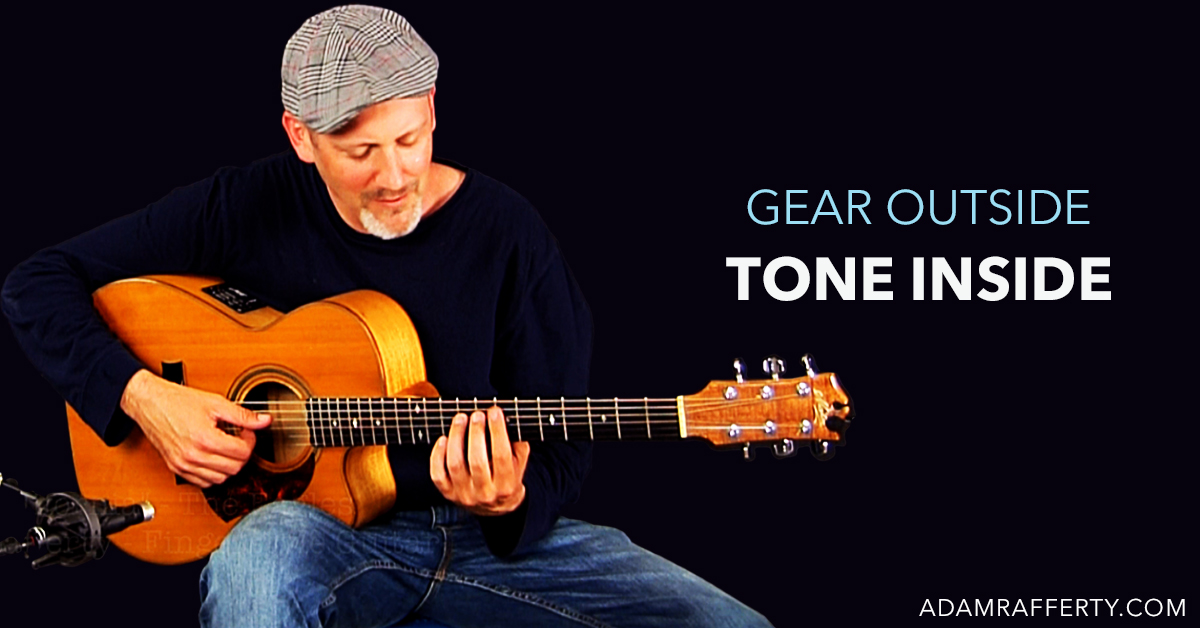
Gear Outside, Tone Inside

By Adam Rafferty 40 Comments

Gear Outside, Tone Inside

I get a lot of questions about my guitar “tone” in my videos.

Ok, yes it has improved since I first started posting videos.  But, this brings to mind a very valuable music lesson I once had from my mentor which I’d like to share with you.

[Read more…] about Gear Outside, Tone Inside

Coffee and Music With a Side Order of Brains, Please

By Adam Rafferty 1 Comment

Greets Gang!

I am freshly caffeinated just out of Starbucks where I received my first “dose” of Holiday Music on the stereo.

As I sat and listened I really enjoyed one of the Ella Fitzgerald tunes – I believe it was “Winter Wonderland”.  Awesome, bluesy and swinging.

Following that, some syrupy more modern version of a Christmas song – sung by a female vocalist came on.  Ugh.  Someone went to the studio to “do their Holiday album” with no concept, no brains, no juice and no soul. I repeat: UGH.

All I could think was “where are the brains behind this music?”

It was perfectly executed, perfectly recorded and mixed…but when you heard it, it was simply a waste of  time.

For music to be successful and truly good – it’s not the choice of tunes that counts, and it’s not even the technical perfection.   Great music requires something more.

There’s a deeper communication in music, and that’s when the musician has dug deep into themselves, found something really special that really resonates with their core being.   After finding this “core resonation”, a true musician practices, refines, crafts something worthwhile, and delivers this to the listener.

It has a great value for the listener, and was not acquired easily or by trickery.  It’s like cooking from scratch vs “just add water.”

What comes to mind is the “breakdown” of the 3 musical stages of development:

  1. Imitation
  2. Realization
  3. Maturity


The imitative stage can be seen in a talented child.  One can become a highly evolved imitator yet never “get it”.  Many pro musicians get stuck here.

You’ve probably heard many professional musicians, bands and producers everywhere playing a very slick and perfect type of music, but with little “character”.  That’s imitative music.  The kind you hear on TV ads.

The other 2 stages – “realization” and “maturity” dawn upon the musician who keeps digging and bases their music on sound concepts and principles rather than copying.

When you hear the sound of a musical personality, like the old blues singer croaking out a tune, or Andre Segovia’s guitar touch and tone, or Paul McCartney singing “Yesterday” you find yourself saying and knowing “this is great!!!!”  That’s “realization” and “maturity” that you are hearing.

That’s self knowledge – coming through the medium of music.  Kind of like…if Rembrandt painted you an apple…it would likely be a masterpiece!

That’s the good stuff.  It arises from practicing deeply and honestly.

So now….git to work!

Little Changes – Big Difference

By Adam Rafferty Leave a Comment

A lot of the time, we want to improve something in our lives – be it our musical ability, career, body weight, financial life, etc.  I was reminded of a very valuable lesson just the other day.

My buddy’s wife is a physical therapist and she kindly showed me a few easy exercises to improve my posture.  After years of hunching over a guitar and a computer, I need chest opening / stand up straight type routines more than “iron pumping” exercises.

She showed me some very easy exercises simply offering a little bit of resistance.   I noticed that her posture was great. I asked her if she worked out and if so, what she did.

“I’ve just been doing these exercises with my patients for 25 years. That’s all.”

Wow.  That inspired me to do the simple things she told me to do….but of course the key is to do it every day!

This reminded me of something Jack Canfield mentioned in one of his programs. Sometimes little changes in life can feel like nothing, but over time they really amount to a big change.

If you were driving straight and just did a one degree turn, eventually that would totally change your direction and bring you somewhere else, right?

Making big changes too suddenly can cause upset; for example in the musical realm if you completely change your technique, you can really hurt yourself!  If you make huge changes in your personal affairs, you often experience upset…it’s good to go slow!

Hopefully this will offer you encouragement to not look for immediate results, yet have the courage to make small changes to achieve your dreams.  See the benefit of doing something slightly new – over time – to achieve a new result.

It may be a new piece you are learning, a scale on your instrument, a new language, a new workout routine, meditation, reading, better eating habit.

Don’t look for results right away…that’s like planting a seed and digging it up the next day to see if it sprouted.

Be happy with an itty bitty small change in a habit, and watch where that takes you over time!

Longo’s List – 10 Study Areas of Music

By Adam Rafferty 34 Comments

Music is a tricky thing to criticize.    Criticism can be good – in terms of listening “critically”.  We all like different things in music, and hear things according to our tastes.

Of course, I need music to ultimately make me “feel good” when i hear it, but here’s a very objective list to help you “picture” the elements of music.

When I started “apprenticing” with my most important teacher, Mike Longo – former pianist and musical director for Dizzy Gillespie, he told me to take out a piece of paper and make the following list.  We did this at lesson #1.

I’d like you to do this with me.  get a piece of paper out yourself and make this list.  If you only read it, it will be a “nice idea”.  I want you to have the list in front of you on your music stand!

Make a heading at the top of the page that says “Guitar“.

This can actually be any instrument, or any style.  If you play “Fingerstyle Guitar” put that at the top of the list.  This list, when finished will be your  main areas of study.

Next, write a line down the middle of the page and make 2 subheadings under the top heading.

“How To Play”  and “What To Play“.

Next, under “How To Play”  write:

  1. Touch
  2. Time
  3. Tone
  4. Technique
  5. Taste

Under “What to Play” write

  1. Harmony
  2. Melody
  3. Rhythm
  4. Counterpoint
  5. Form

“What to Play” can generally be written on paper in a book form – it’s “information”  much like a cookbook.

“How To Play” is a bit more elusive….some chalk it up to “feeling” but it’s much more than emotion.  It’s intuition and experience.  More on that in another post.

These 10 areas of study pretty much cover all of it!  So, if you are working on one area, be content with that and just work on the one area.

As you listen to yourself and others, or any music at all, try to think critically – have all of these 10 areas been covered?

I often hear fingerstyle guitar music lacking in the “melody” area.  Or if there’s a full evening of rubato improvisation, maybe “form and rhythm” are weak or missing.

Personally I had to deal with “touch” and “taste” when doing the I REMEMBER MICHAEL cd…those were the weak spots during my creation process.

Or, when I practice the Bach E Major Prelude, it’s still in need of better “technique” and fingerings.

I’m telling you this so that you can see I try to stand back from what I do, listen, think, and improve my own music.

So there’s always room to improve and grow for all of us!

Remember – when you listen critically you are not attacking a “person” , whether it’s yourself or another guitarist.

You are just simply verbalizing which area of the “music” (not the person) could stand improvement.

Now….git to work!

  • « Go to Previous Page
  • Go to page 1
  • Interim pages omitted …
  • Go to page 12
  • Go to page 13
  • Go to page 14
  • Go to page 15
  • Go to page 16
  • Interim pages omitted …
  • Go to page 27
  • Go to Next Page »
Learn my arrangements, get personal feedback and more. Try Study With Adam FREE for 14 days CLICK HERE

Adam Rafferty

Copyright © 2026 Adam Rafferty and Crescent Ridge Publishing | Email Policy | Privacy GDPR, & Cookies